
How to Find and Fix a Roof Leak
By Jay Romano
Repairing a leaky roof is a challenge under the best of circumstances. Just pinpointing the leak’s location often takes persistence, detective work and a fair amount of luck.
When the leaky roof is also an apartment building’s “backyard,” as in the case of a rooftop terrace, repairs can be expensive and vexing for a building’s owner.
“The tricky part is avoiding doing more work than is necessary,” said Stephen Varone, Director of Operations of RAND Engineering in Manhattan.
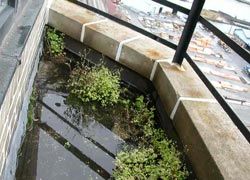
Multiple Layers
In New York, he explained, most roof decks, or terrace floors, consist of layers of different materials. For example, he said, it is not uncommon for a roof deck in a high-rise residential building to be made of a substructure of steel topped by a concrete deck, which is topped by a waterproof membrane. This membrane is itself topped by wood decking or, more commonly, with a layer of sand or mortar, which is then topped with paving bricks or quarry tile.
“Leaks often aren’t easy to find,” Mr. Varone said. While water will sometimes leak from a hole or crack in the surface of a roof deck directly into the ceiling or wall of the apartment below, it more often moves around a bit before making its way out.
Leaks take the path of least resistance, and it’s often difficult to pinpoint where water enters.
“A leak will take the path of least resistance,” he said. “It might be coming right down through the concrete or it might be running along the supporting steel under the roof deck and then coming down somewhere else.”
Regardless of where the water comes out, preventing it from entering in the first place will solve the problem. Just where the water is getting in, however, usually isn’t easy to figure out.
“Normally, the first thing we do is a controlled flood test,” Mr. Varone said. “We’ll plug up any drains in the roof and use a hose to flood the area. Sometimes we’ll put a colored dye in the water. Then we go downstairs and try to determine where the water is coming from.”
While locating the entry point of a leak from its exit point is not always possible, the problem is magnified, Mr. Varone said, when the roof also serves as a terrace and is covered with tile or brick.
“The most difficult scenario is when you have old quarry tile set in mortar,” Mr. Varone said. “It is often necessary to rip up the quarry tile to locate where the water is getting in.”
Infrared Detection
Michael Ahearn, the owner of Seaboard Weatherproofing in Port Chester, NY, said another way to locate a leak was to use an infrared detector.
“The detector is used to find heat in the deck,” Mr. Ahearn said. “Since water is liquid, its temperature changes more rapidly than the substrate it’s worming its way through.” The infrared detector would then detect a difference in temperature, which would translate to moisture.
In most cases, he said, the roof (or terrace) surface is divided into a grid with readings taken at every grid point.
Liquid roofing membrane can be applied in one continuous coating, leaving no seams.
Once the source of the leak is found, Mr. Ahearn said, the decision must be made to either repair the leak or replace the entire roof membrane. “If you have a leak in a specific spot, we’ll go to that spot first and pull up whatever topping is over the membrane,” he said. “But if you don’t see a hole or some sort of deterioration at that spot, it’s kind of a crapshoot from there.”
In fact, Mr. Ahearn said, in many cases it is necessary to remove all of the topping material—whether bricks, pavers, tile or even wood—to get down to the roof membrane.
“In most cases, if you’re going to the trouble of tearing up the topping, you might as well replace the membrane,” he said.
Roof membrane—that is, the waterproof covering typically applied on top of the concrete decking—can be either hot or cold liquid, which is basically squeegeed onto the surface, or “sheet goods” that are rolled out and stuck to the decking. (In some cases, the roof membrane is just laid on the concrete surface and held in place by the weight of whatever topping material is used.)
“The most common hot membranes are coal-tar-based materials, asphalt-based materials and rubberized asphalt,” he said, explaining that in most cases, a layer of tar paper is sandwiched between two layers of hot liquid topping.
An alternative to hot liquid membranes is a relatively new liquid material that can be applied cold.
Steven Tingir, Chief Specification Writer for RAND Engineering, said that one advantage of any liquid membrane material is that it can generally be applied in one continuous coating and, as a result, leaves no seams.
An added advantage of cold liquid roofing membranes, he said, is that the material can be used on almost any roof.
“If you have a wood roof, the Fire Department won’t let you bring a kettle up to the roof,” he said, referring to the machine used to melt hot-applied asphalt materials. “You have to put the kettle on the street and then pump the hot asphalt to the roof.”
With a cold liquid, however, it is not necessary to use a kettle.
“Basically, you apply the membrane by pouring it on and spreading it out with a squeegee,” Mr. Tingir said. “And once you distribute it, you unroll reinforcing fleece over it and then go over the fleece with a roller to make sure it absorbs the liquid.” Once that is done, he said, another layer of liquid membrane is applied on top of the fleece material. It is also possible, Mr. Tingir said, to apply sheet membranes to the roof surface.
He said such materials, known as modified bitumen roofing membranes (basically asphalt treated with additives and reinforced with fiberglass or polyester), are rolled out and glued to the roof deck with material that acts as an adhesive. Particular attention must be paid to mixing the adhesive, Mr. Tingir said. “If the mixing is not done properly, problems may arise in adhering the membrane.”
Another relatively new product, he said, is a roof membrane that already has the adhesive applied to it. “It’s a peel-and-stick kind of thing,” he said. “You prime the surface and then directly adhere the roll to the deck and go over it with a 75-pound roller.”
Generally speaking, Mr. Tingir said, sheet roofing costs about $17 a square foot, including removal and disposal of the existing roofing material. Liquid roofing, on the other hand, costs about $20 a square foot.
Paver Systems
To use a roof as a terrace, it is usually necessary to install yet another layer of material on top of the membrane.
Walter Sedovic, a preservation architect in Irvington, NY, said one option was to cover the membrane with “pavers.”
“They’re concrete, 2 feet by 2 feet, and they come in a variety of colors and styles,” he said. The pavers, he said, are mounted on adjustable plastic pedestals—one at each corner of the block—which permit water to flow beneath then and follow the natural pitch of the roof.
Another option, he said, is bricks or pavers set in a two-inch layer of sand.
This will not drain as quickly as the pavers, but the sand keeps the terrace permeable, he said, adding that screens are installed around the perimeter of the area to prevent the sand from washing down the drain pipes.
Yet another possibility, Mr. Sedovic said, is to install quarry tiles—6 inch by 9 inch clay-fired tiles—in a bed of mortar instead of sand. With such a roof, he said, the top level of the quarry tiles have to mimic the pitch of the roof so that the water drains properly off the surface. “It’s very important to build in an expansion joint every 15 to 20 feet,” he said, explaining that such a joint allows the surface to expand and contract without cracking.
The most ecologically friendly roof surface material, Mr. Sedovic, is not man-made.
“My favorite system is a grass-roof system,” he said. “Grass used to require about eight inches of dirt. But now there are systems that can be installed with as little as two inches of dirt.”
While dirt and grass may not seem the best materials to use on a roof—or a terrace—grass could possibly triple the life of a roof.
“Grass roofs are absolutely stunning,” Mr. Sedovic said. “And they don’t need as much mowing as you might think.”
This article was originally published in The New York Times as “How to Fix a Roof Leak: First, Find It,” September 28, 2003.